

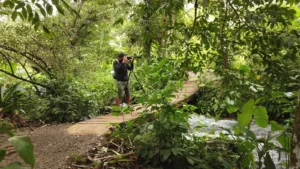



Birding Tapir Valley, Tenorio Rainforest, Costa Rica
A private reserve on the Caribbean slope of Volcán Tenorio, where the Snowcap, three toucans and a lagoon with Baird’s tapirs share the same forest.
Tapir Valley is a private reserve in the Tenorio Rainforest, on the Caribbean slope of Volcán Tenorio and next to Tenorio Volcano National Park, where the reserve reports more than 440 bird species and eBird holds 475 species on 3,819 checklists. The Snowcap is on 56% of checklists, and between 44% and 67% in every month, and the Yellow-throated Toucan on 77%. We bird it as a private full day from the Guanacaste, Costa Rica coast.
Where Two Slopes
Meet
The Tenorio Rainforest sits in the gap between Volcán Tenorio and Volcán Miravalles, where the dry Pacific side of Costa Rica meets the wet Caribbean side. In 2005 three local families bought a 100-hectare cattle ranch here, next to Tenorio Volcano National Park, to protect its birds. Restoration began in earnest in 2016: the cattle came out, forest was planted in the lower areas and the old lagoon was restored. The first Baird’s tapirs were seen that year, among them a female with her calf. Today rainforest, the lagoon and its wetlands hold birds of both slopes. On our morning there in October 2026 we logged Hoffmann’s Woodpecker, a dry-forest bird, and Black-cheeked Woodpecker, a Caribbean one, on the same short walk. The wetlands are also the only known home of the Tapir Valley tree frog, Tlalocohyla celeste, first found here in 2018 and described as a new species in 2022.
Rainforest, a lagoon and its wetlands now hold birds of both slopes.
Tapir Valley, in one look
| Where | In the Tenorio Rainforest, near Bijagua de Upala, Alajuela, on the Caribbean slope of Volcán Tenorio |
|---|---|
| Pickup | Timed so you reach Tapir Valley between 6:30 and 7:00; leave about 2 hours before from Playas del Coco and the RIU hotels, 2½ hours from Las Catalinas, 2¾ hours from Tamarindo and 1 hour from Liberia |
| Protection | Private nature reserve, founded in 2005 on a 100-hectare cattle ranch, bordering Tenorio Volcano National Park in the Tenorio–Miravalles Biological Corridor |
| Habitat | Primary and regenerating rainforest, a restored lagoon, wetlands, streams and forest edge |
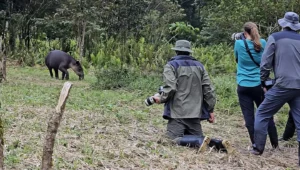
| Wildlife | More than 440 bird species, over 50 reptiles and about 50 frogs reported by the reserve; at least six or seven Baird’s tapirs move through it, plus howler monkeys, white-faced capuchins and agoutis |
| Terrain | Trails walked at birding pace, with some wet and muddy stretches; on our October 2026 morning we walked 1.27 km in four and a half hours |
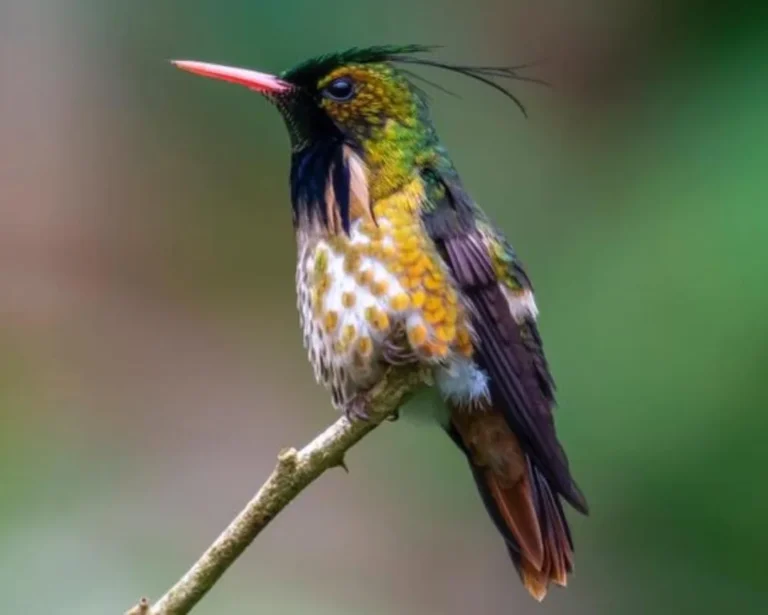
| Best months | All year for the Snowcap and the toucans; February to May for the Black-crested Coquette; September to December for the Ornate Hawk-Eagle |
| eBird hotspot | Bijagua–Tapir Valley: 475 species on 3,819 checklists, more than 100 complete checklists in every month |
| Our last visit | 12 October 2026: 71 species on one complete eBird checklist. Read the trip report |
Last verified October 2026 by Miller Contreras, naturalist guide and wildlife photographerFigures are the share of complete eBird checklists that report each species at the Bijagua–Tapir Valley hotspot, as a yearly average or by month. Source: eBird, Cornell Lab of Ornithology, read October 2026.
Which month is best for Tapir Valley?
The Snowcap and the toucans are there all year. What changes is the rest: the Black-crested Coquette peaks from February to May, the Ornate Hawk-Eagle from September to December.
Tap a bird to see its months
Snowcap: best in August, on 67% of checklists.
See all the numbers as a table
| Bird | Jan | Feb | Mar | Apr | May | Jun | Jul | Aug | Sep | Oct | Nov | Dec |
|---|---|---|---|---|---|---|---|---|---|---|---|---|
| Snowcap | 54% | 62% | 62% | 66% | 52% | 50% | 60% | 67% | 55% | 56% | 46% | 44% |
| Black-crested Coquette | 46% | 64% | 63% | 59% | 54% | 26% | 5% | 0% | 1% | 19% | 45% | 30% |
| Collared Aracari | 69% | 67% | 45% | 32% | 16% | 19% | 51% | 38% | 35% | 33% | 40% | 58% |
| Great Curassow | 53% | 56% | 53% | 50% | 38% | 49% | 63% | 47% | 26% | 18% | 33% | 48% |
| Crested Guan | 32% | 37% | 52% | 50% | 44% | 41% | 64% | 45% | 29% | 31% | 20% | 31% |
| Ornate Hawk-Eagle | 12% | 11% | 9% | 5% | 5% | 4% | 10% | 6% | 22% | 20% | 22% | 21% |
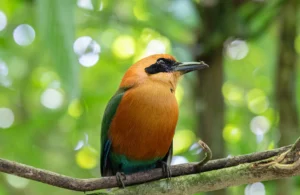
| Tody Motmot | 9% | 17% | 21% | 23% | 31% | 32% | 24% | 24% | 25% | 28% | 14% | 14% |
| Yellow-eared Toucanet | 21% | 6% | 1% | 0% | 1% | 4% | 2% | 1% | 1% | 1% | 0% | 4% |
| Checklists | 283 | 300 | 337 | 217 | 246 | 150 | 115 | 106 | 116 | 184 | 142 | 196 |
Share of complete eBird checklists that report each species at the Bijagua–Tapir Valley hotspot, by month; the three best months of each bird are highlighted. Source: eBird, Cornell Lab of Ornithology, read October 2026.
The Snowcap, three toucans and a lagoon with Baird’s tapirs share the same forest.
Which birds can you see at Tapir Valley?
You will see birds on every visit. What we can’t promise is which ones, so here they are sorted honestly.
Reliable
Reported on most visits, all year.
Big birds and specialties
Often, never every day.
Possible, never promised
We will look hard. We will not promise.
If you come for one bird, tell us before the day. The forest has the last word, but we will put you in the right place at the right hour.
A private full day at Tapir Valley
We leave early to be in the forest for the first, busiest hours. Tapir Valley is one of the two reserves of our Tenorio Rainforest birding day, together with Heliconias. The day is spent at one reserve, the one you choose; if the hours allow, we close it with a second walk in the Tenorio Rainforest.
A day at Tapir Valley
The usual rhythm of the day. We adjust it to your hotel and your target birds.
Timed so you reach Tapir Valley between 6:30 and 7:00, when the birds are most active. The exact time depends on your hotel.
Forest trails, the fruit feeders and the lagoon edge, with snacks in the field.

Lunch is included.
If the hours allow, a second birding walk in the Tenorio Rainforest to close the day, then the drive back to your hotel.
What the day includes
Everything is private: your group never joins strangers.
A private naturalist guide specialized in birds, private transportation, park entrances, binoculars and a spotting scope, bottled water, snacks and lunch. Taxes included.
Gratuities.
Light clothes, long pants, closed shoes, insect repellent and a rain jacket all year: this is the wet side of the volcano.
Seventy-two hours before your birding day begins, counted from your pickup time and not the day: cancel before that for a full refund.
A day at Tapir Valley, in their words
“Bryan is an amazing birding expert who helped us spot more than 50 species of birds we’d never seen before while exploring a beautiful private nature reserve called Tapir Valley Nature Preserve… Bryan and Miller are the real deal.”
Bryan Montoya was born in Bijagua and has birded the Tenorio corridor all his life. For another morning at the reserve with Bryan and Miller, read our trip report from 12 October 2026.
More birding sites near Guanacaste
Each site has its own season. See where to bird in Guanacaste, Costa Rica and the best time for birding, month by month.
Rincón de la Vieja
The top eBird hotspot in Guanacaste, Costa Rica: manakins, motmots and magpie-jays below the volcano.
ExploreHeliconias
Hanging bridges and a trail to Laguna Danta in the Tenorio Rainforest, with 488 bird species on eBird.
ExploreValle de los Quetzales
The Resplendent Quetzal on 85% of eBird checklists in May, and the endemic Coppery-headed Emerald.
ExploreBirding Tapir Valley,
Tenorio Rainforest, Costa Rica
Send Us Your Dates
and Your Target Birds
Tell us when you are coming and which birds you are after. We will tell you honestly what is realistic for your dates and plan the day around it.
Private groups only · Hotel and LIR pickup · Based in Playas del Coco, Guanacaste, Costa Rica