




Best Time for Birding in Costa Rica, Month by Month
When the migrants arrive, when the quetzal nests, when the wetland birds move, and which site to pick from your Guanacaste, Costa Rica hotel in each month, with the eBird figures behind it.
The best time for birding in Costa Rica is December to April: the northern migrants are in, the dry season makes the roads easy, and the wetlands of Guanacaste, Costa Rica concentrate their waterbirds. For the Resplendent Quetzal, come between February and June. For the dry-forest specialties, May and June. For wetland birds in the green season, September to November. Resident rainforest birds, toucans included, are there in every month.
What is the best month for birding in Costa Rica?
It depends on what you came for. Three goals, three different answers.
The longest list
December to April. Resident birds plus the northern migrants, and dry roads to reach more sites in a day.
The Resplendent Quetzal
February to June, at its strongest from March to May, when the birds are nesting in the highlands.
Fewer people, greener forest
May to November. The dry forest peaks in May and June; the wetland birds move to the coast from September.
Birding in Costa Rica, month by month
What changes each month, where we would take you from a hotel in Guanacaste, Costa Rica, and the figure that backs it. Percentages are the share of complete eBird checklists that report the bird at that site.
| Month | What is happening | Where we would go | The figure |
|---|---|---|---|
| January | Dry season settles in. Northern migrants are wintering, and the lagoons of Palo Verde begin to shrink. | Palo Verde · Tenorio rainforest | Migrants and residents together |
| February | Waterbirds gather inland. The quetzal season opens in the highlands. | Palo Verde | Roseate Spoonbill 60% at Palo Verde |
| March | The peak of the inland wetland. Quetzals nesting. | Palo Verde · highlands | Wood Stork 63%, Jabiru 37% at Palo Verde |
| April | Last month of the dry season. Migrants start to leave; the quetzal season is at its height. | Palo Verde · highlands | Quetzal season, March to May |
| May | The first rains turn the dry forest green and the forest birds become active. Global Big Day falls in May. | Rincón de la Vieja · Santa Rosa · Monteverde | Long-tailed Manakin 79% at Las Pailas · Elegant Trogon 57% at Santa Rosa · Quetzal 40% at Monteverde |
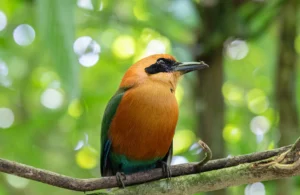
| June | Dry-forest birds still at their best. The Three-wattled Bellbird calls in the cloud forest. | Rincón de la Vieja · Monteverde | Turquoise-browed Motmot 62% at Las Pailas |
| July | Green season. A short dry spell, the veranillo, often comes this month. Resident birds, few visitors. | Tenorio rainforest · Rincón de la Vieja | Resident birds all year |
| August | Green season continues. The first southbound migrants appear. | Tenorio rainforest | Resident birds all year |
| September | The rice fields flood and the wetland birds move toward the coast. Migration in full swing. | Farm wetlands near the coast | Wood Stork 65%, Roseate Spoonbill 41%, Jabiru 37% in the farm wetlands |
| October | One of the wettest months, and the best for wetland birds near the coast. October Big Day falls this month. | Farm wetlands near the coast | Wood Stork 79% in the farm wetlands |
| November | The rains ease toward the end of the month. Migrants settled for the winter. | Farm wetlands · Tenorio rainforest | Wood Stork 76% in the farm wetlands |
| December | The dry season returns and the waterbirds start moving back inland. Peak travel weeks. | Palo Verde · Tenorio rainforest | Book early for mid-December to mid-January |
Source: eBird, Cornell Lab of Ornithology, hotspot data as of July 2026. For Guanacaste, Costa Rica weather and travel by month, see our best time to visit Guanacaste guide.
Each habitat has its own season
Northwest Costa Rica puts four habitats within reach of one hotel. Their best months complement each other.
Dry Forest
- Rincón de la Vieja and Santa Rosa
- Long-tailed Manakin, Elegant Trogon, Turquoise-browed Motmot
- White-throated Magpie-Jay on 68% of Las Pailas checklists, all year
Wetlands
- Palo Verde in the dry months
- The flooded rice fields near the coast in the rains
- Wood Stork, Roseate Spoonbill and, with luck, the Jabiru
Rainforest
- The Tenorio, a day trip from the coast
- Toucans, motmots, manakins and hummingbirds, including the Snowcap
- Yellow-throated Toucan on 43% of Río Celeste trail checklists
Cloud Forest
- Monteverde and the highlands
- Resplendent Quetzal, at its strongest March to May
- Three-wattled Bellbird in May and June, roughly one visit in three
Is the green season good for birding?
Yes, and for some birds it is the best season. In Guanacaste, Costa Rica the dry season runs from December to April and the green season from May to November. Green-season rain tends to come in the afternoon, and birding happens in the early morning, so most days you lose very little. What changes is where the birds are: the wetland birds leave Palo Verde for the flooded fields near the coast, and the dry forest, brown and quiet in March, turns green and loud in May. The right site for the month matters more than the month itself.
Best Time for
Birding
Tell Us Your Dates.
We’ll Pick the Site.
Send us your travel dates and your target birds. We will tell you honestly what is realistic for those weeks, and which site to choose from your hotel in Guanacaste, Costa Rica.
Private groups only · Hotel and LIR pickup · Based in Playas del Coco, Guanacaste, Costa Rica