




Why you won’t see a sloth in Guanacaste
Guanacaste’s coast is dry forest — sloths need wet forest. Here’s where they actually are, how far it is, and how we find them.
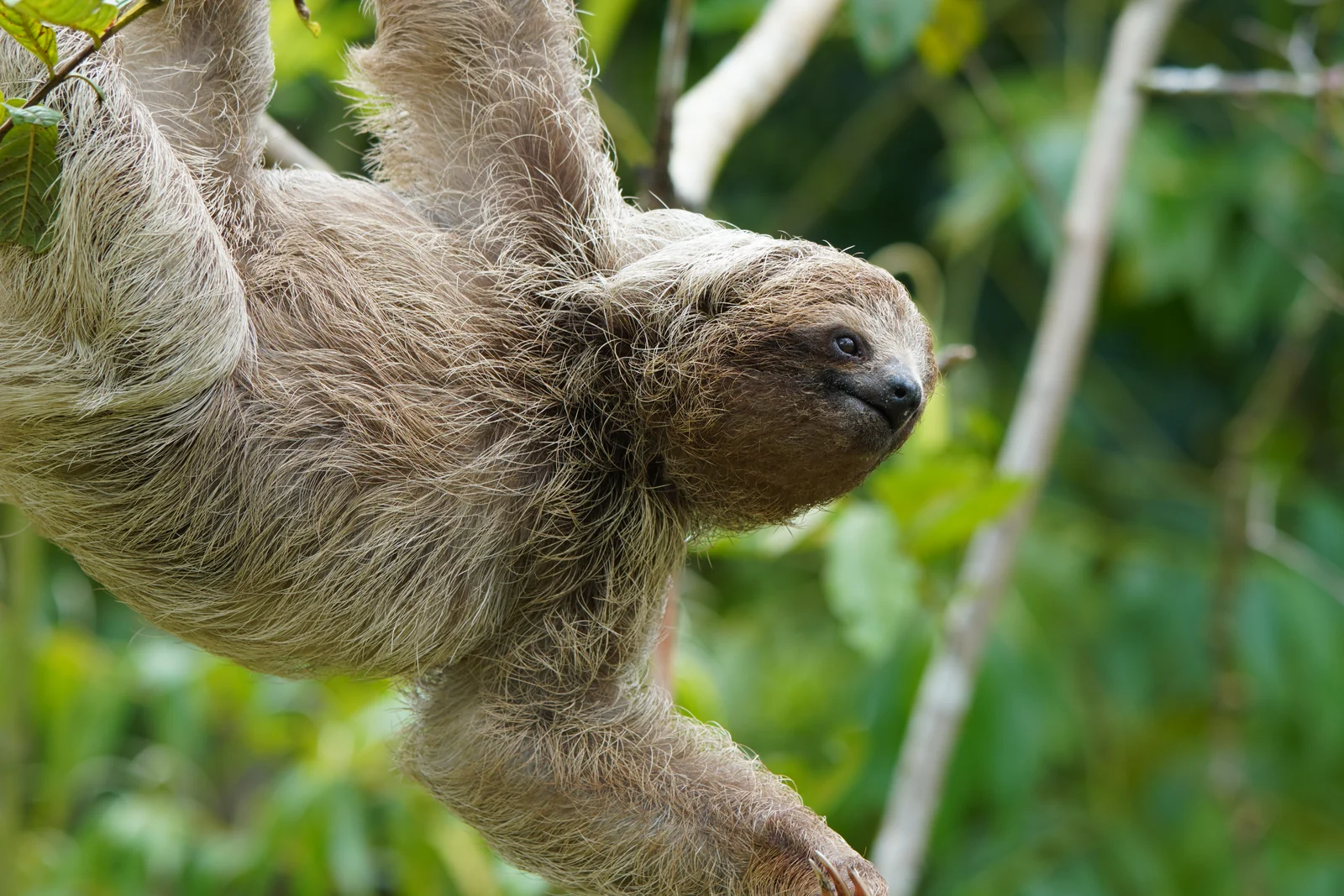
There are no wild sloths on the Guanacaste coast — it’s dry forest, and a sloth can’t live there. But the Tenorio rainforest, an hour and a half inland, is full of them. That’s where we take you.
Let’s start with the part nobody selling you a tour wants to say out loud: there are no wild sloths in Guanacaste.
Not on the beach at Playa Conchal. Not in the trees behind your resort in Papagayo. Not in Tamarindo, not in Playas del Coco, not in Sámara or Nosara. If you’re staying at the Westin, the RIU, Secrets, Planet Hollywood or the Andaz and you’ve been scanning the treetops hoping one is up there — it isn’t.
This isn’t bad luck or bad timing. It’s ecology. And once you understand why, you’ll also understand exactly where to go and what to look for — which is what the rest of this guide is about.
Why the Guanacaste coast has no sloths
Gold and bare, half the year
For six months it barely rains and the trees drop their leaves. Spectacular for howlers, iguanas, magpie-jays and birds — but no year-round canopy, no stable humidity, no way for a sloth to live.
Wet, leafy, alive all year
A permanently leafy canopy to eat and hide in, and the humidity a sloth’s slow biology depends on. This is the belt inland from the coast — and it’s where the sloths are.
A sloth eats almost nothing but leaves, and those leaves are so poor in calories that the animal has evolved to spend as little energy as possible getting them. Take away the year-round canopy and it simply has no way to live. So sloths in Costa Rica live where it stays wet: the Caribbean side, the southern Pacific, and — the one that matters for you — the rainforest belt inland from the Guanacaste coast.
They’re closer than you think
From anywhere on the Gold Coast, the nearest genuine sloth habitat is the Tenorio rainforest, around the small town of Bijagua between the Tenorio and Miravalles volcanoes, beside the Río Celeste.
That’s less than half the drive to La Fortuna, the other common answer — and the Tenorio rainforest is quieter, wetter, and in our experience considerably better for actually seeing the animals. The Riu link is private tours from the Riu resorts at Playa Matapalo.
The reason is botanical: the Tenorio rainforest is thick with guarumo (the cecropia tree), the preferred food of the three-toed sloth. Where the guarumo grows dense, the sloths follow.
Costa Rica’s two sloths — and why their names are wrong
There are six sloth species in the world. Costa Rica has two, and they are far more different from each other than most visitors realize. First, a few numbers that overturn what everyone thinks they know:
| Three-toed sloth | Two-toed sloth | |
|---|---|---|
| Scientific name | Bradypus variegatus | Choloepus hoffmanni |
| When it’s active | Daytime — the one you’ll usually see | Night — much harder to find |
| Diet | Leaves, almost exclusively | Leaves, fruit, flowers, buds, even insects |
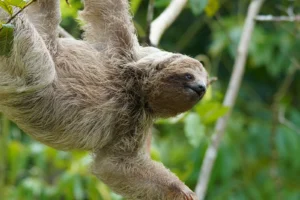
| Face | Dark markings that look like a permanent smile | Bigger eyes, longer snout |
| Size | Smaller | Larger, around 5–6 kg, and more agile |
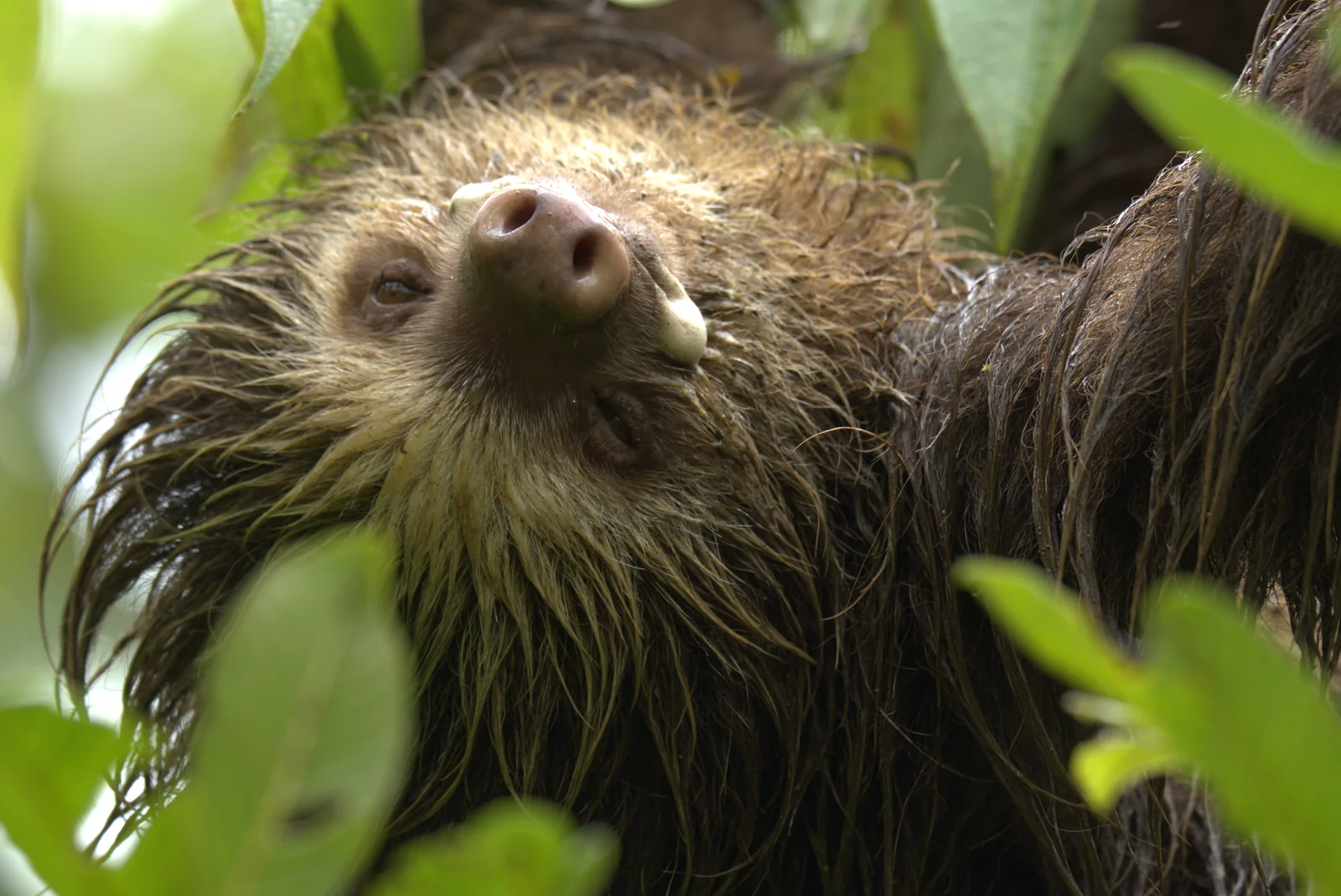
Now, the detail that surprises almost everyone: the names are botanically wrong. Every sloth species has three toes on its back feet. The difference is in the hands — one has two fingers, the other three. That’s why modern research papers call them two-fingered and three-fingered sloths. It’s a small correction, but it tells you something: almost everything most people “know” about sloths turns out to be slightly off.
Three myths worth clearing up
They sleep twenty hours a day.
That figure comes from captive animals. Wild sloths sleep eight to ten hours — roughly what you do.
They’re lazy.
They’re efficient. Their metabolism runs at about half the rate of similar mammals, and a single meal can take up to thirty days to digest. Eating leaves in the treetops forces an animal into life in the slow lane — which is why fast animals don’t eat leaves, and why ground-dwelling leaf-eaters like deer have to be big.
They’re always brown.
A sloth’s fur is its own ecosystem — moths, mites and green algae. Older animals look distinctly green, which is the point: camouflage against jaguars and eagles looking up from below.
One more, because it’s the strangest fact about them: a sloth comes down to the ground roughly once a week, and only to defecate. It’s the most dangerous thing it does all week, and biologists still argue about why an animal built for the canopy insists on doing it down there.
How we actually find them
This is the part visitors ask about most, so here it is — the real method, not the tourist version.
We don’t look for a sloth. We look for an interruption.The thing thirty years teaches your eye
You cannot find a sloth by looking for the shape of a sloth, because from below it doesn’t look like an animal at all. What we look for is anything that doesn’t belong in the pattern of the forest. A canopy has a texture — leaves, branches, gaps of sky, shafts of light. After thirty years your eye learns that texture the way you’d know a familiar face. When something breaks it, you notice before you can even say what it is.
Usually it reads as a shadow. Or as a termite nest — a dark, rounded lump wedged where a branch forks. That’s the shape you’re hunting: not an animal, an interruption. Much of the time it’s the light that gives them away — the way sunlight falls through the canopy tells you where the solid things are.
Height tells you who you’re looking at
Here’s something you won’t read in a field guide, and it comes from years of watching the same forest: sloths sort themselves by height.
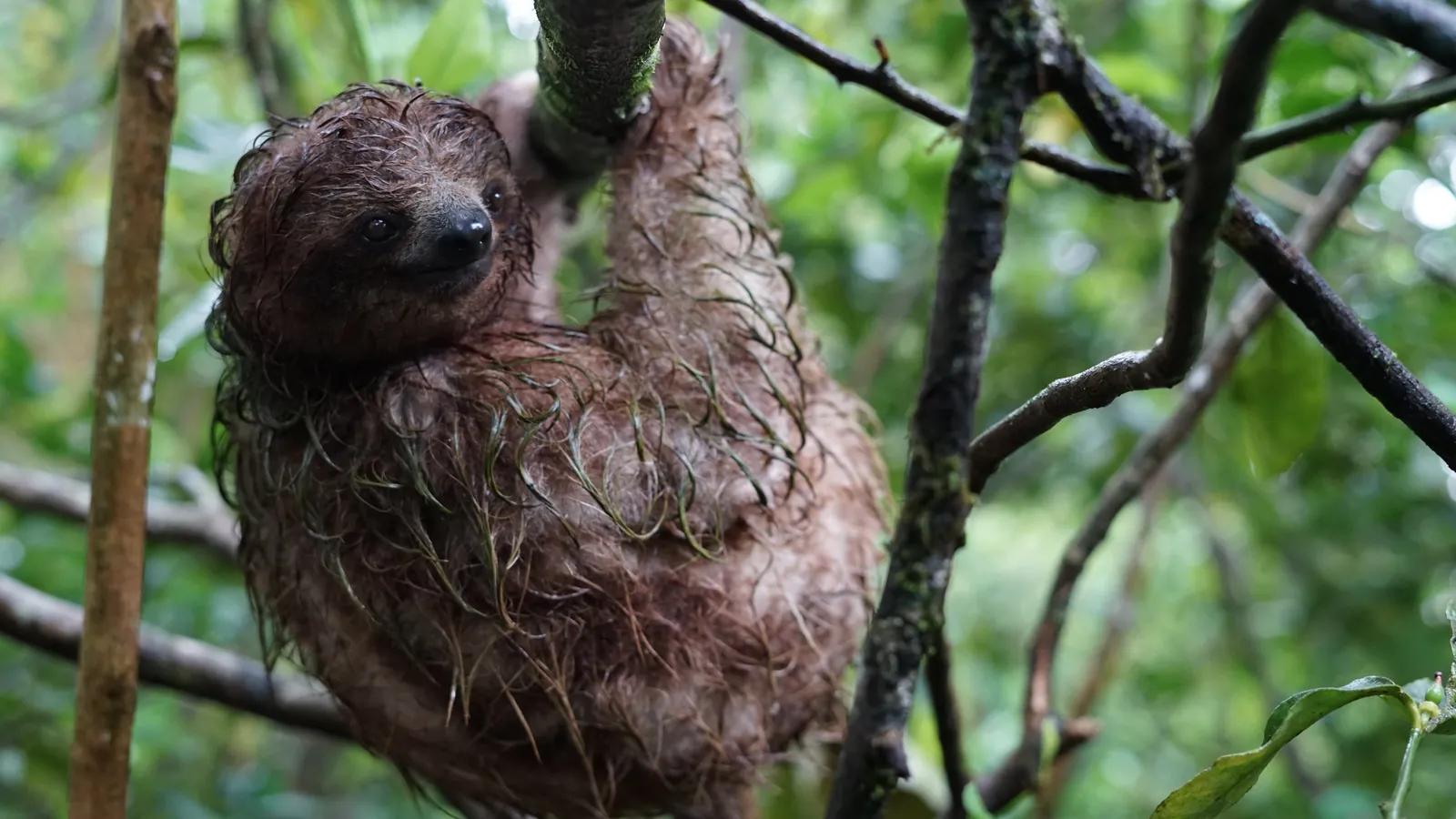
They’re solitary and territorial
A common misconception is that finding one sloth means there are others right beside it. There aren’t. Sloths are solitary and quite territorial, and they keep their distance. What is true is that where conditions are right — cooler, wetter, plenty of guarumo — you’ll find more sloths across the same area. Not clustered, just more of them spread through good habitat. Which is exactly why where you go matters more than how long you look.
The equipment — and the thing equipment can’t replace
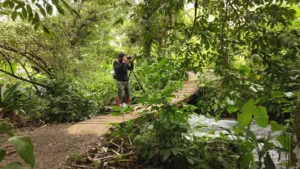
Binoculars help. A spotting scope changes everything — at canopy height the naked eye gives you a lump, and the scope gives you a face, the claws, the algae in the fur, the slow blink. But the real advantage isn’t optical. It’s that a local guide knows where sloths were seen yesterday. An animal that moves about thirty-five metres in a day is still roughly where it was — worth more than any technique in this article.
Private tour from Guanacaste
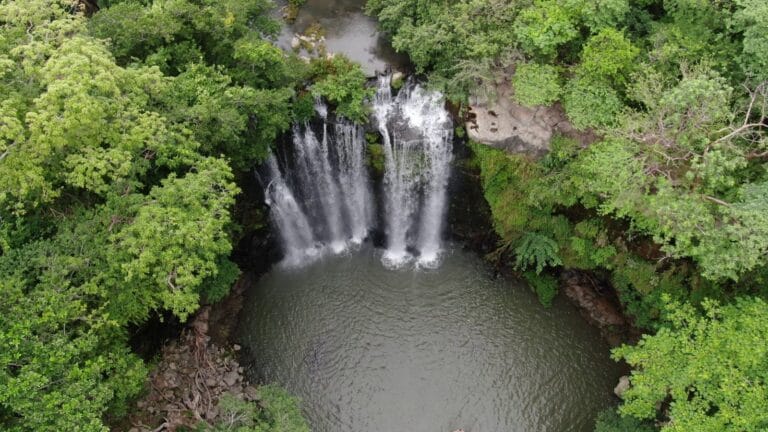
Sloth & Waterfall Rainforest Combo
A private day in the Tenorio rainforest, about two hours from the coast: the private reserves where we go looking for sloths, plus the Llanos de Cortés waterfall. Your own naturalist guide and transport from your hotel.
What a morning actually looks like
On a normal walk through the private reserves we use in the Tenorio rainforest, guests see between seven and ten sloths. Not one, if we’re lucky — seven to ten. Both species live there, though the three-toed is far more common during daylight hours.
We were standing with a group, everyone lined up behind the scope watching a sloth feeding in a guarumo, when there was a crash in the leaf litter behind us. A two-toed sloth had fallen out of its tree — landed a few metres away, entirely unbothered, and began the slow business of climbing back up. The group forgot the one in the scope completely.
It happens more than you’d think. They fall, they land, they climb back. Their bodies are built for it.
You’ll see fauna. The last word belongs to the forest.
We don’t oversell it. We take you into real sloth country, with someone whose eye has learned that forest over thirty years — and who knows which tree held one yesterday. On a normal morning that means seven to ten. What no honest guide promises is a specific animal on a specific branch.
What else lives out there
The forest around Tenorio isn’t just a place with sloths in it. Tenorio Volcano National Park is the most biodiverse protected area in the entire Arenal-Tempisque Conservation Area, and part of the UNESCO-designated Water and Peace Biosphere Reserve. It protects over 18,000 hectares, and because it catches weather from both the Caribbean and the Pacific slopes, it packs an unusual number of life zones into a small space:
There’s even a tree here found nowhere else: the jícaro danto (Parmentiera valerii), endemic to the Guanacaste mountain range, and one of the main foods of the endangered Baird’s tapir. If the forest itself pulls at you more than the checklist, read our full guide to the Tenorio rainforest.
Watching them responsibly
Sloths are gentle and almost defenceless, which is exactly why the rules matter.
Three things decide whether it happens
- Go where they live. From the Guanacaste coast, that means the Tenorio rainforest — an hour and a half inland, and worth every minute.
- Go with someone who knows the ground. Not for the technique — you’ve just read the technique — but because knowing which tree held a sloth yesterday is the difference between a good morning and a great one.
- Go slowly. Whatever else you do, don’t walk that forest like you’re late for something.
Before you go looking
Not on the dry coast or the beaches — sloths need wet rainforest, which the Guanacaste coastline isn’t. But about an hour and a half inland, in the Tenorio rainforest, yes. On a normal morning there guests see seven to ten.
The Tenorio rainforest is about an hour and a half from Playas del Coco or Papagayo, an hour and three quarters from the Riu resorts, and two and a half hours from Tamarindo — less than half the drive to La Fortuna, and quieter and wetter for actually seeing sloths.
The three-toed sloth is active by day — the one you’ll usually see — smaller, with dark markings like a permanent smile. The two-toed is larger, active at night, with bigger eyes and a longer snout. Curiously, the names are botanically off: both have three toes on their back feet; the real difference is two versus three fingers on the hands.
No — that figure comes from captive animals. Wild sloths sleep about eight to ten hours, roughly what a person does. They’re not lazy but efficient: their metabolism runs at about half the rate of similar mammals, and a single meal can take up to thirty days to digest.
Rather do it than read about it?
We run this as a private day trip from anywhere on the coast — your group, your guide, your pace. Tell us what you’d like to see.