




Frogs of Costa Rica near Guanacaste: red-eyed & poison dart
The postcard frog, the jewel-bright dart frogs, a masked cousin, and a species so new it was found by ear — and where to actually see them.
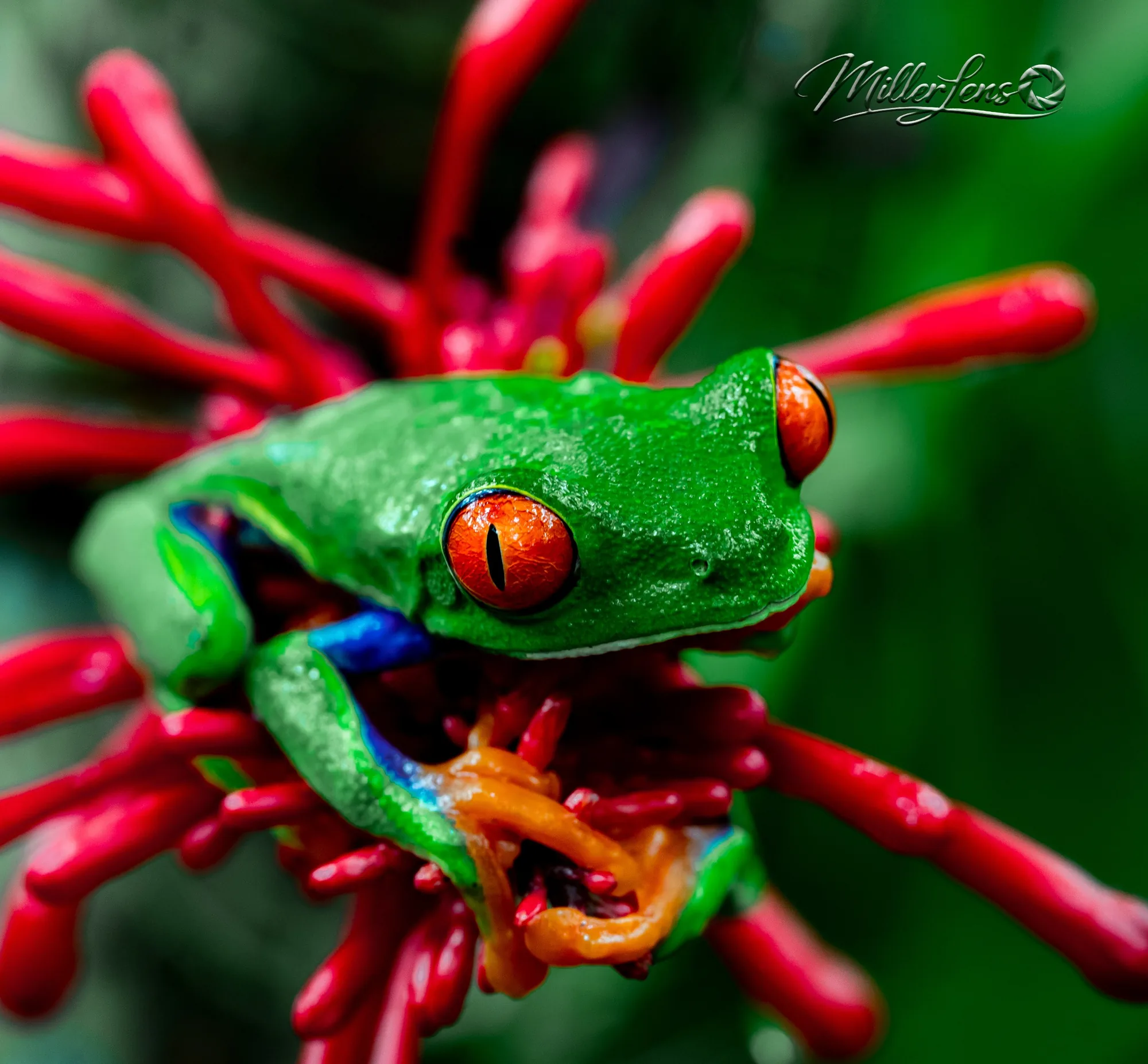
The red-eyed tree frog is the face of Costa Rica — but these frogs live in humid rainforest, not on the dry Pacific coast of Guanacaste. To find red-eyed tree frogs and the tiny poison dart frogs in the wild, you go inland to the wet forest of the Tenorio rainforest — the same green country as the sloths and toucans. That’s where we take you, on foot with a naturalist who knows the leaves to check.
Ask a traveler to picture Costa Rica and they almost always land on the same image: a lime-green frog with huge red eyes, clinging to a leaf. It’s on every postcard and magnet in the country.
What most people find out too late is that this frog — and the little poison dart frogs that share the postcard rack — are creatures of wet rainforest. The dry Pacific coast where the beach towns sit isn’t where they live. But drive inland an hour and a half, into the Tenorio rainforest, and the whole cast is there.
How many frogs does Costa Rica have?
Two groups are the ones travelers come hoping to see, and they couldn’t be more different in how they live.
The red-eyed tree frog (Agalychnis callidryas)
Bright lime-green body, blue-and-yellow striped flanks, orange feet, and those unmistakable red eyes. Its scientific name comes from Greek for “beautiful tree nymph,” which fits.
Here’s the surprise: it’s not poisonous. All that color isn’t a warning — it’s a trick. By day the frog sleeps folded on the underside of a leaf, eyes shut, its green eyelids and tucked limbs hiding every bright color, so it simply vanishes into the foliage. If a predator finds it anyway, the frog suddenly snaps its huge red eyes open and flashes the blue-and-orange it was hiding. That burst of color — biologists call it startle (deimatic) coloration — freezes a bird or snake for a split second, and a split second is all the frog needs to leap.
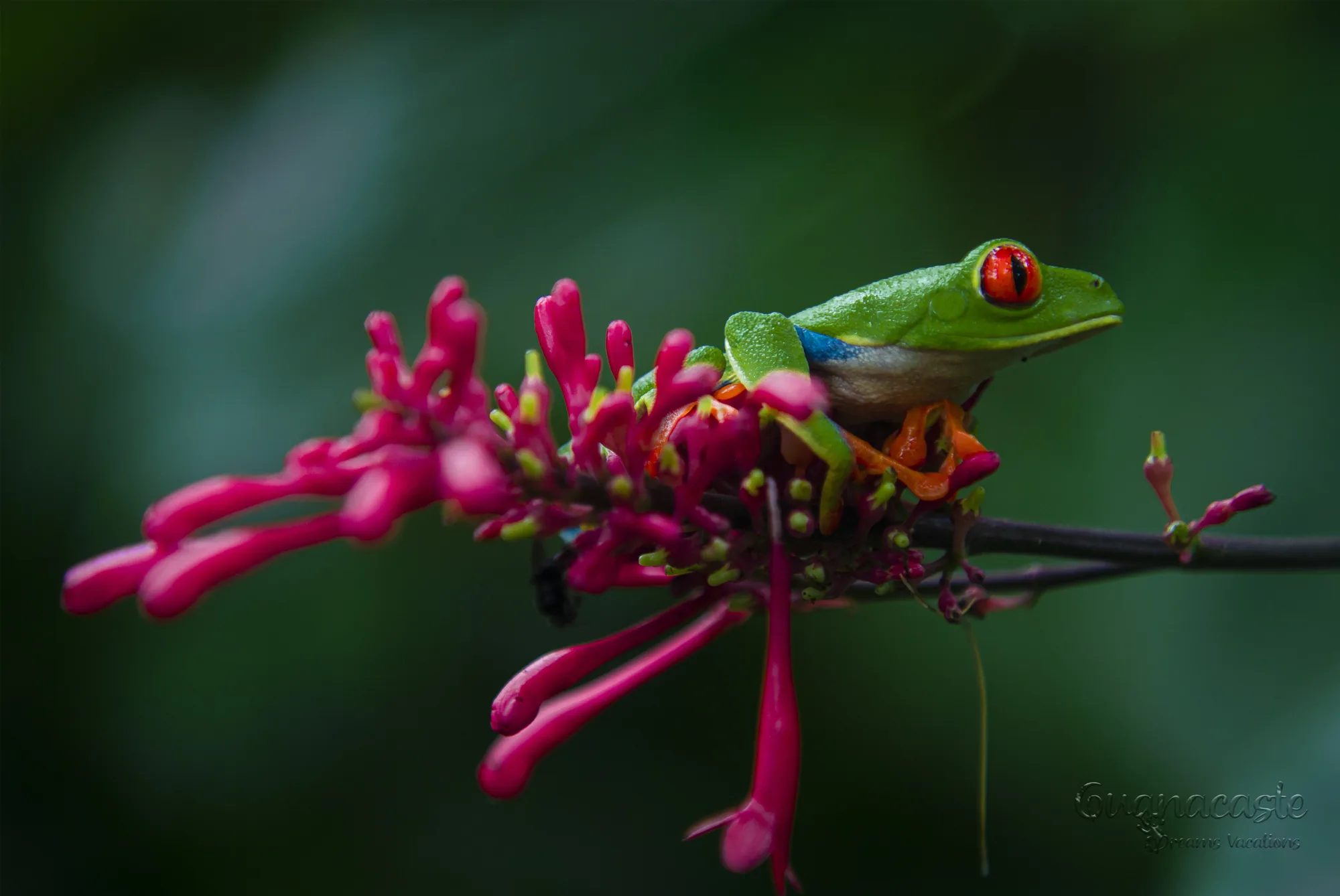
A few more things worth knowing before a walk: it’s strictly nocturnal — by day you’re looking for a sleeping green lump under a leaf; at night the forest fills with their short, clicking calls. It can change shade with its mood, going deeper green or reddish-brown when cool or stressed. And it lays its eggs on a leaf hanging over water, so the hatching tadpoles drop straight in — remarkably, the embryos can hatch early if they feel the vibration of a snake attacking the clutch, an escape hatch built into the egg.
The other frog on the leaves — the masked tree frog
The red-eyed frog gets the postcards, but it isn’t the only tree frog you’ll meet on a night walk here. Look closely and you’ll find the masked tree frog (Smilisca phaeota) — named for the dark band that runs across each eye like a bandit’s mask. It’s not decoration: predators lock onto a prey’s eye, and the mask breaks up that tell.
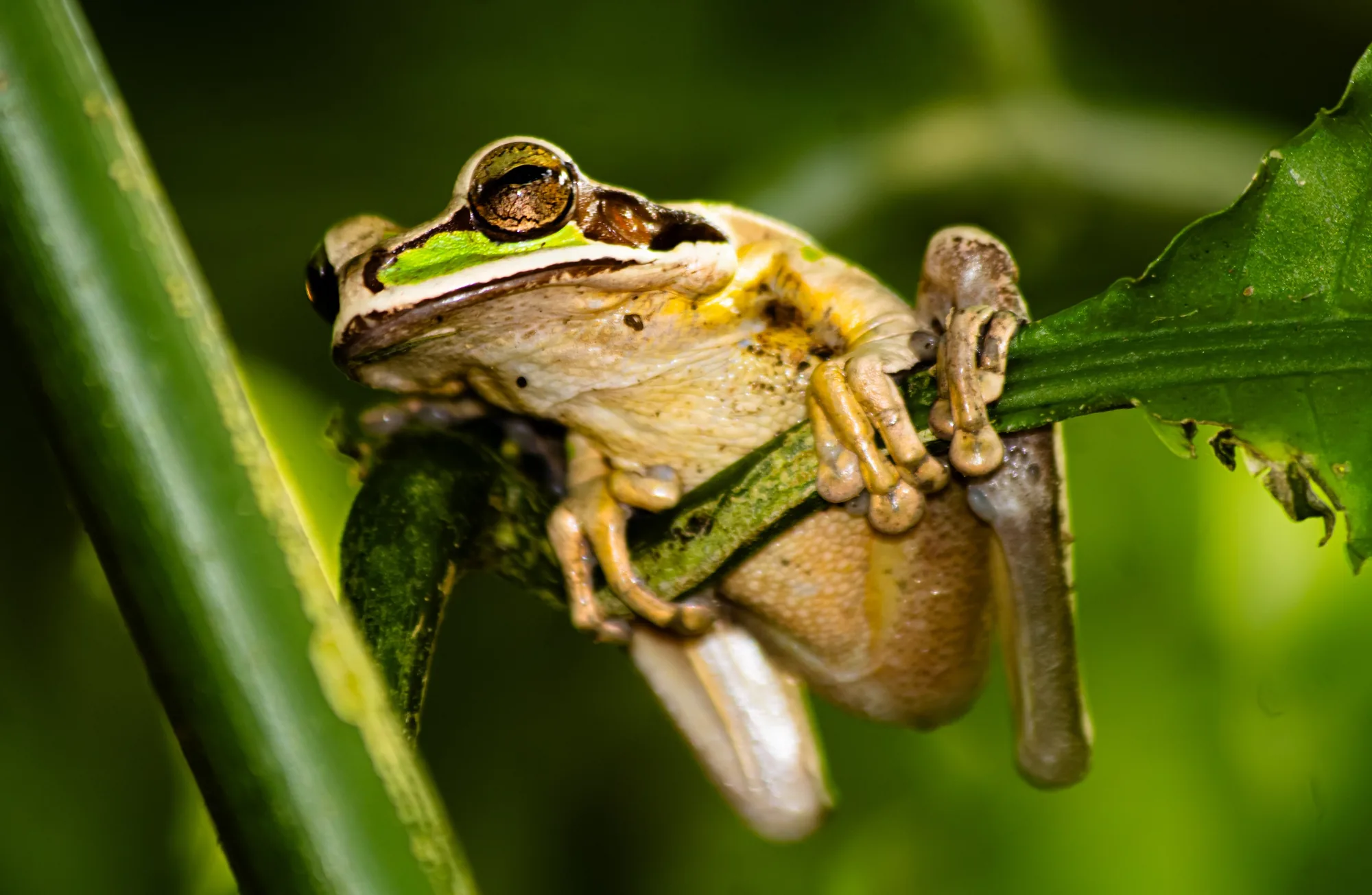
Like the red-eyed frog it’s a quiet shapeshifter, wearing a plain tan by day and turning green after dark, and it spends the daylight tucked into a rolled leaf or a clump of ferns. It lays its eggs on leaves over water too. Learn its call and you’ll start noticing it all through the forest after rain.
Poison dart frogs — tiny, bold, and out by day
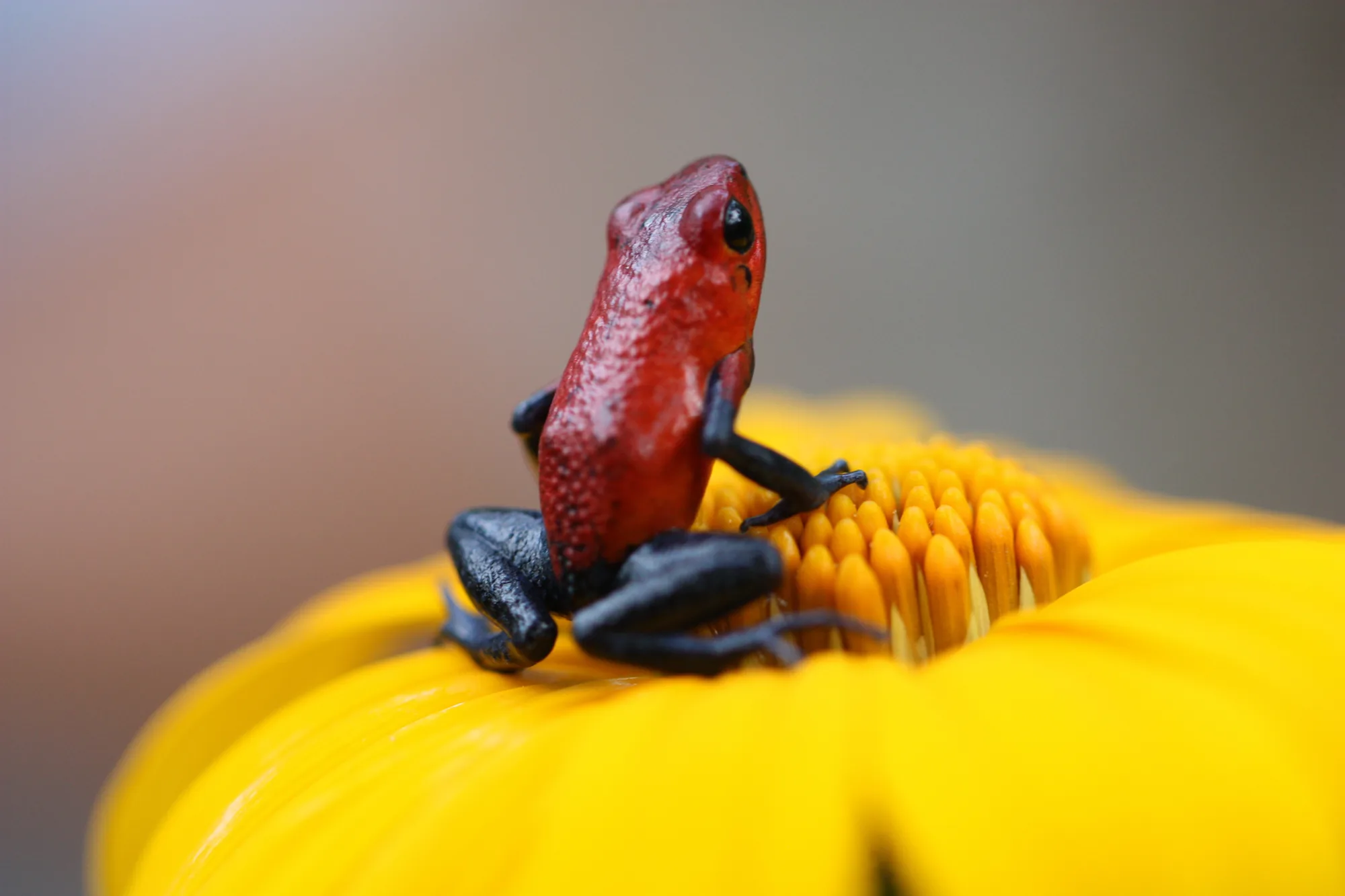
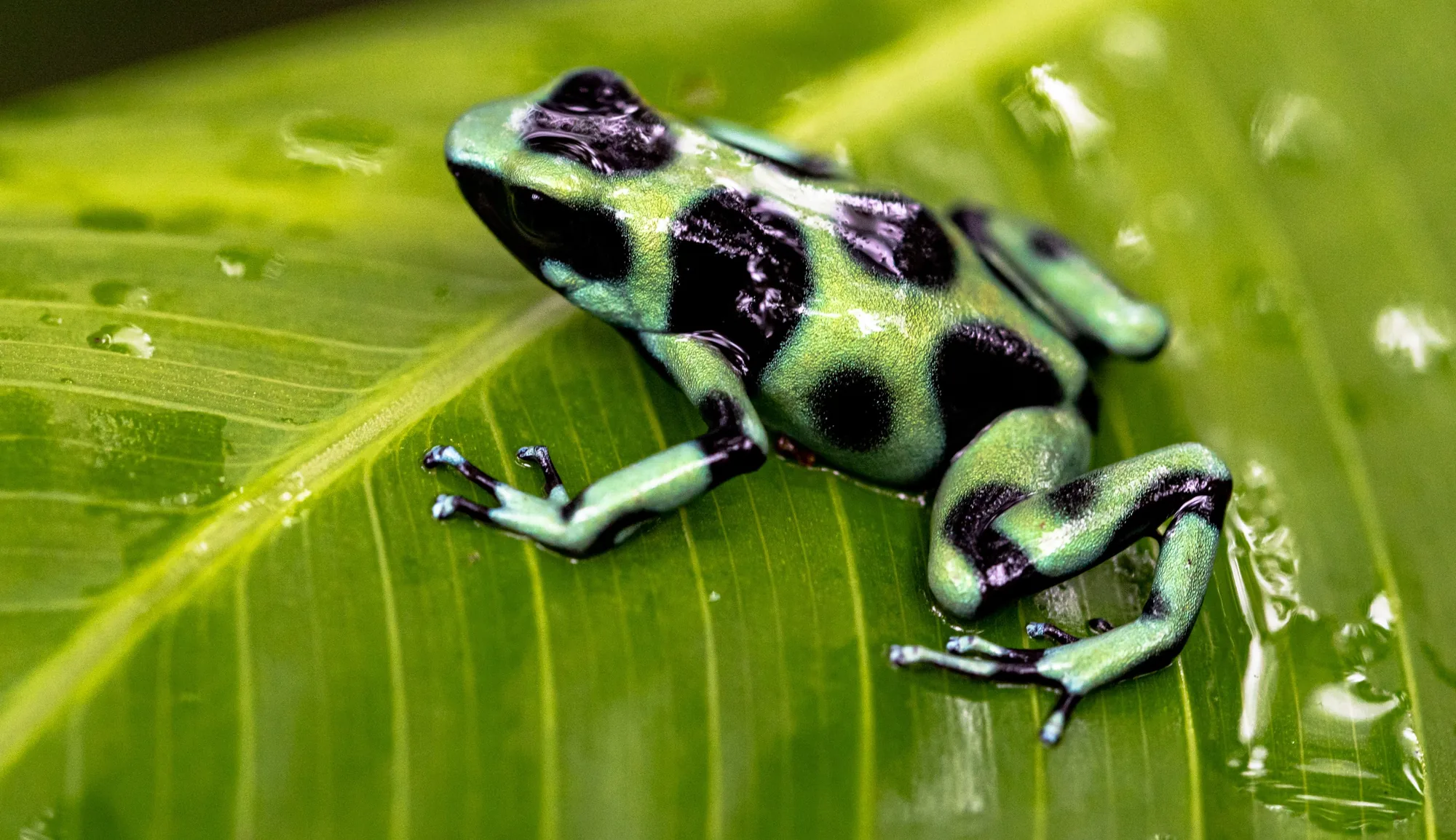
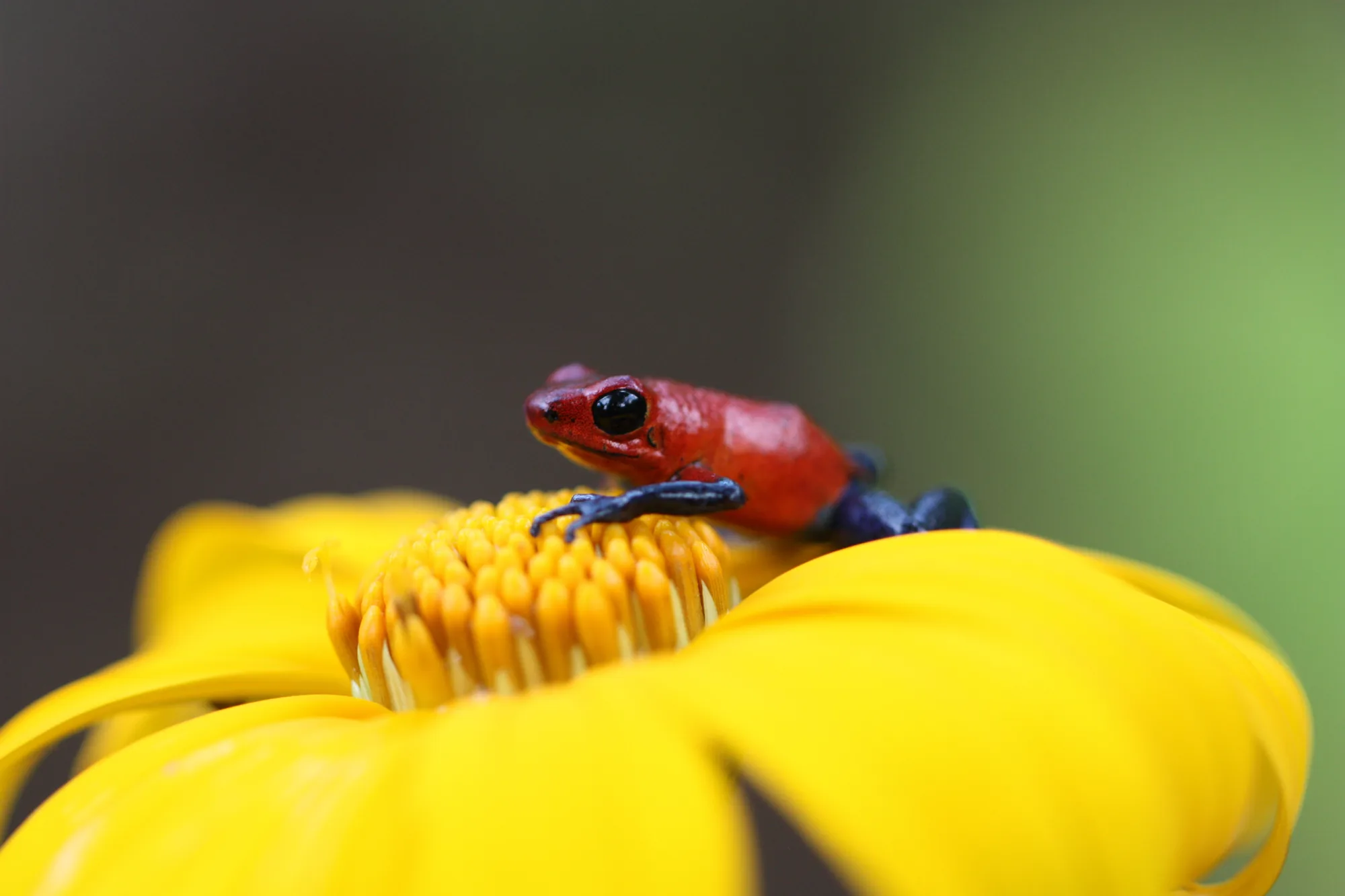
The other icon, and the opposite personality. Where the tree frogs hide by day and hunt by night, poison dart frogs are out in daylight, hopping across the leaf litter — small, jewel-bright, and unafraid, because their color is a genuine warning.
The one you’re most likely to meet is the strawberry poison dart frog (Oophaga pumilio), nicknamed the “blue jeans” frog — brilliant red body with blue legs, barely the size of a thumbnail. There’s also the striking green-and-black dart frog. Their skin really does carry toxins — that’s not a myth — though a Costa Rican dart frog’s toxin is mild and can’t pass through unbroken skin.
Which brings up the one rule that matters most out there.
We look, we don’t touch — and neither should any tour
You’ll see photos all over the internet of a red-eyed tree frog posed on someone’s fingertip. We don’t do that, and we’d gently steer you away from anyone who does.
A frog’s skin breathes and absorbs — it’s how the animal takes in water and oxygen — so a human hand, with sunscreen, bug spray, oils and salt on it, is genuinely harmful, and handling stresses a small animal badly. The dart frogs carry toxins besides. A good sighting is one where the frog never knew you were there. Our guides carry good eyes and, when useful, a scope or a careful light — so you get the close look and the photo, and the frog gets left in peace.
Private tour from Guanacaste
Sloth & Waterfall Rainforest Combo
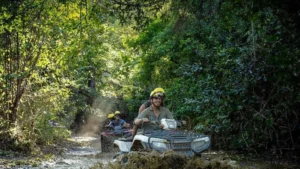
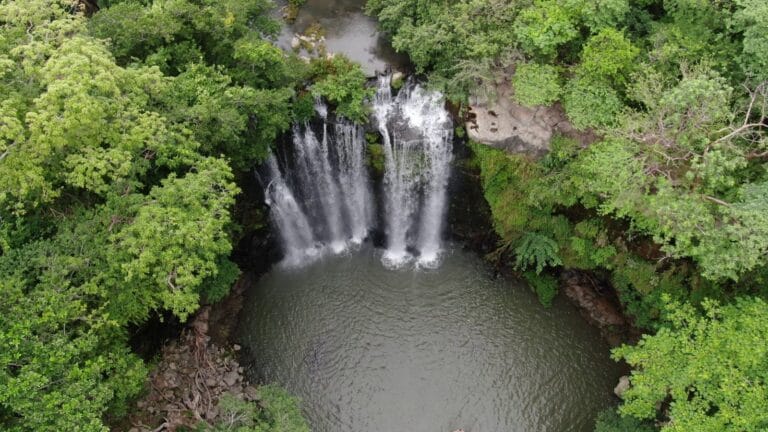
A private day in the Tenorio rainforest, about two hours from the coast: rainforest trails where we look for frogs, sloths and whatever else the forest shows us, plus the Llanos de Cortés waterfall. Your own naturalist guide and transport from your hotel.
The glass frog — you can watch its heart beat
Some of the most extraordinary frogs here you could hold up to the light and almost read a newspaper through. Glass frogs have translucent skin on the belly — clear enough that, on many species, you can see the heart beating and the bones and organs through it. From above they’re a soft, spotted green; it’s the underside that gives them their name.
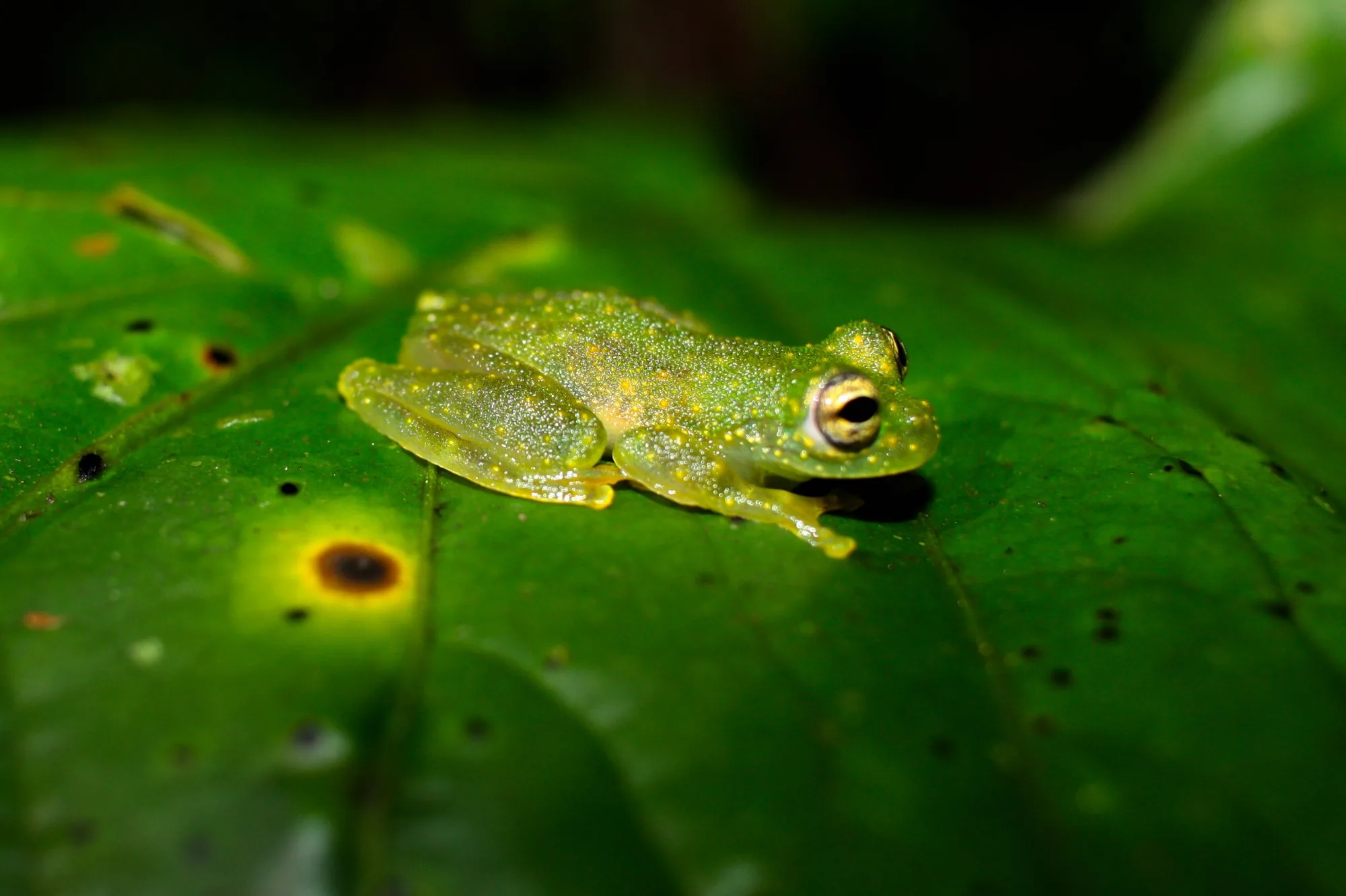
They’re small, nocturnal, and tend to perch on leaves over running water, where the males call and guard the eggs. Spotting one is a quiet thrill — a reminder that the best things in this forest are rarely the loudest.
The frog that was found by ear
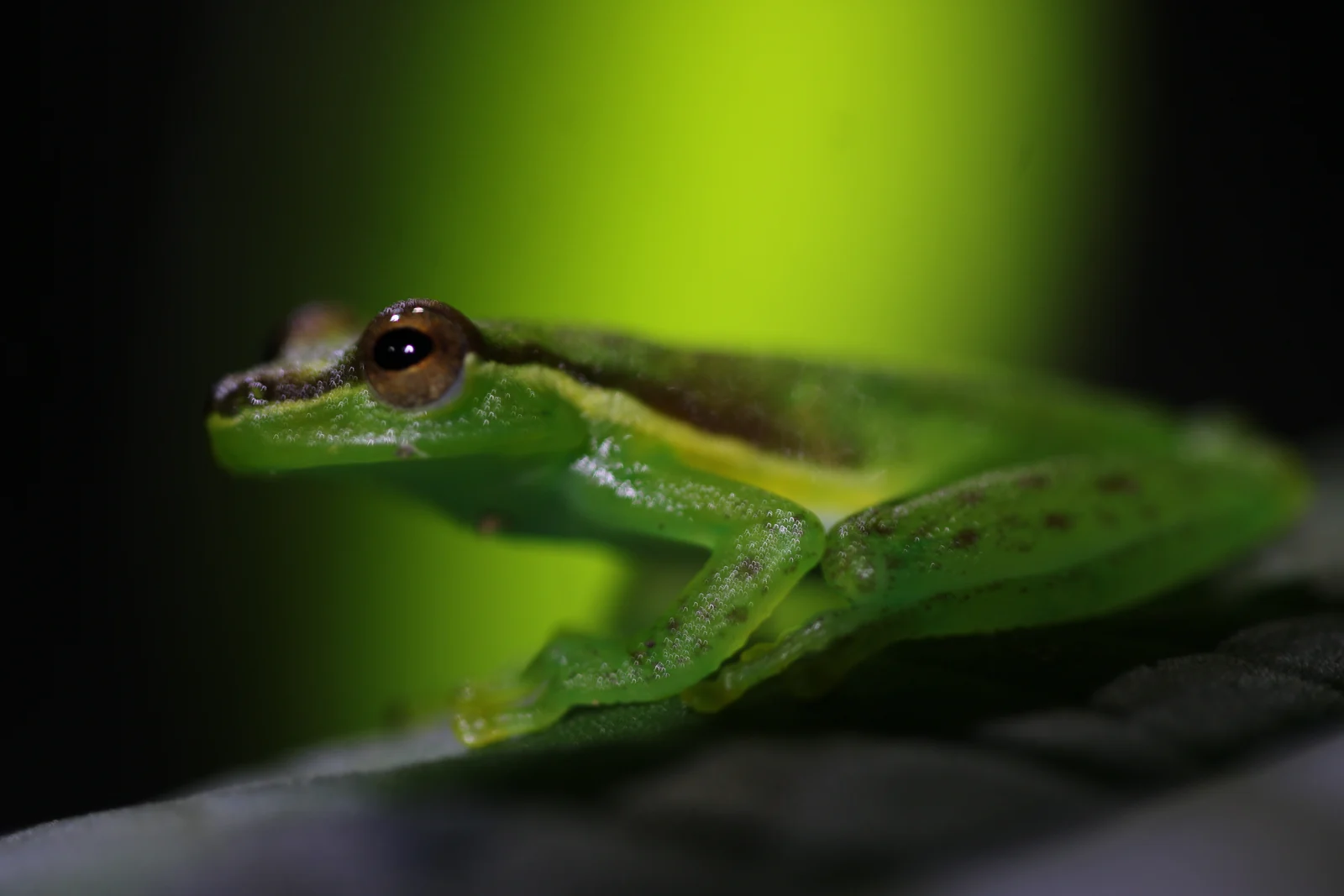
Here’s a story that belongs to this exact patch of forest. In 2022, science described a brand-new frog: Tlalocohyla celeste, the Tapir Valley tree frog — about two centimeters, brilliant green with a flash of blue in the armpit and reddish freckles. It was first found not by sight but by sound: Donald Varela Soto, a Costa Rican naturalist guide and co-owner of the Tapir Valley reserve — a former cattle ranch given back to the forest — kept hearing a call he couldn’t place, and followed his ear until he found the frog making it.
It’s only the fifth species of its genus known anywhere in the world; its nearest cousin lives 500 km away in Honduras; and it lives right here, between the Tenorio and Miravalles volcanoes, in Bijagua.
Honesty first: this frog lives in a single protected wetland of about eight hectares, likely critically endangered, inside that reserve. It isn’t a frog you’ll turn up on any walk, and we’d never pretend otherwise. It’s here as the pride of the place — proof of how much life this small stretch of Costa Rica still holds.
Many more, if you know how to look and listen
The famous faces are just the doorway. This forest holds a real share of Costa Rica’s ~150 frog species — most people never notice, because frogs are small, still, and usually heard long before they’re seen. A few you might cross or hear on a walk in the Tenorio rainforest:
- Fleischmann’s glass frog — barely an inch long and lime-green, with a belly clear enough to see the heart beating; it perches on leaves above streams.
- The tink frog — that single metallic “tink… tink” ringing through the dark is one of the most common voices of this slope; you’ll hear a hundred before you see one.
- Rain frogs and litter frogs — the little brown “oh, another frog” ones bouncing through the leaf litter; plain-looking, but they run the forest floor.
- The South American bullfrog — big, dark and loud, one of the largest frogs down here.
- The marine toad — the heavyweight of the group, out at dusk near clearings and water.
On a slow walk with someone who knows the calls, the forest turns out to be full of frogs you’d otherwise have stepped right past.
Where to see them, from the Guanacaste beaches
Frogs need moisture and rainforest, so — like the sloths and toucans — the place to find them is inland, not on the dry coast. On our Rainforest Combo experience in the Tenorio rainforest, you’re in the wet forest, streams and leaf litter where the red-eyed tree frog, the dart frogs and the glass frogs all live, along the greener trails toward Río Celeste and the Green Lagoon.
Dart frogs are daytime frogs, so you can meet them on a normal forest walk. Red-eyed tree frogs are night animals — the classic way to see one awake and glowing is a guided evening walk, which we can arrange on request. If a night walk is what you’re after, just tell us when you message and we’ll set it up. As always, we take you where they live and read the leaves for you; we don’t promise a particular frog on a particular night.
And you don’t have to wait for a season. The Tenorio rainforest stays wet and green all year, so the frogs are always here — the rain just turns up the volume. In the green season (May–November) the night chorus is at its loudest, but the frogs never really pack up.
You’ll see fauna. The last word belongs to the forest.
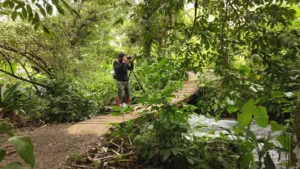
We take you into real rainforest, on foot, with someone who knows which leaves to turn and which calls to follow. What no honest guide promises is a specific frog on a specific night — but the forest is generous, and the walk itself, chorus and all, is the thing.
Before you go looking
Not on the dry Pacific coast where the beach towns are — they need humid rainforest. The nearest wild population is inland, in the Tenorio rainforest, roughly 1h30–2h away, which is where we take guests to find them.
No. Despite its bright colors, it isn’t poisonous. The colors are a startle defense — it flashes its red eyes and blue-and-orange flanks to spook a predator for the split second it needs to escape. (Poison dart frogs are the toxic ones — and even theirs is mild.)
No, and it’s for the frog’s sake. Their skin absorbs whatever is on your hands, and handling stresses them badly; dart frogs are toxic besides. We show you frogs up close in the wild without touching them — that’s the ethical and the better way to see one.
Year-round. The Tenorio rainforest stays wet and green all year, so frogs are always active; the green season (roughly May–November) just makes the night chorus louder. Dart frogs are out by day; red-eyed tree frogs are night animals, so an evening walk is the classic way to see one awake.
Rather see them than read about them?
We run this as a private day in the Tenorio rainforest — your group, your guide, your pace. Tell us what you’d like to find.