




Toucans in Guanacaste, Costa Rica: The Six Species — and Where to See Them
Climb inland into the Tenorio rainforest, and toucans become a real and regular sight. Three species live in that greener country — here’s how to find them.
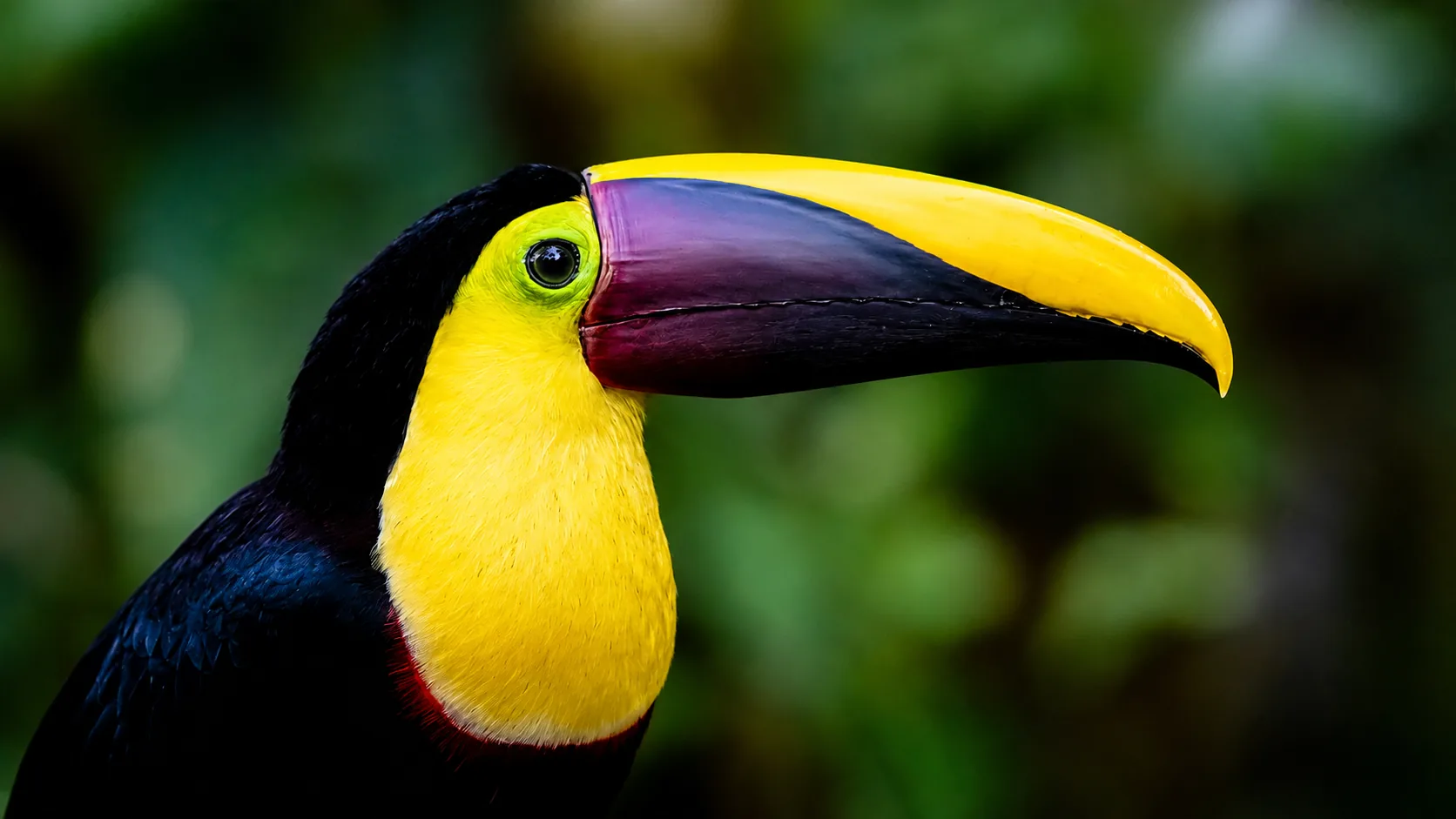
If you’re staying on the dry Pacific beaches of Guanacaste — Coco, Tamarindo, Papagayo, Flamingo — you’ll hear toucans talked about more than you’ll see them. The open, seasonally-dry coast isn’t where they concentrate. But climb inland toward the Tenorio rainforest, near the town of Bijagua, Costa Rica, and toucans become a real and regular sight. Three of Costa Rica’s six species live in that greener country, and knowing where the fruiting trees are is most of the game. That’s the part a local guide brings.
Six, if you count the whole family (Ramphastidae) — and birders do. They split into three pairs by size: two true toucans (the big ones), two aracaris (medium, slimmer), and two toucanets (the small mountain ones). No single place has all six. Where you are decides which you’ll meet.
Yellow-throated Toucan — the chestnut-mandibled
Known for decades as the chestnut-mandibled or Swainson’s toucan (Ramphastos ambiguus swainsonii), recently reclassified as the Yellow-throated Toucan — the name that matches what you actually see: that blazing yellow throat and chest. The bill is two-toned, dark above and yellow-green below, and its call is a far-carrying two-note yelp — Dios te dé, Dios te dé in local tradition — you’ll hear it across a valley long before the bird appears. Common in rainforest on both slopes; on our routes it shows up in the wetter forest inland, in the Tenorio rainforest.
Keel-billed Toucan
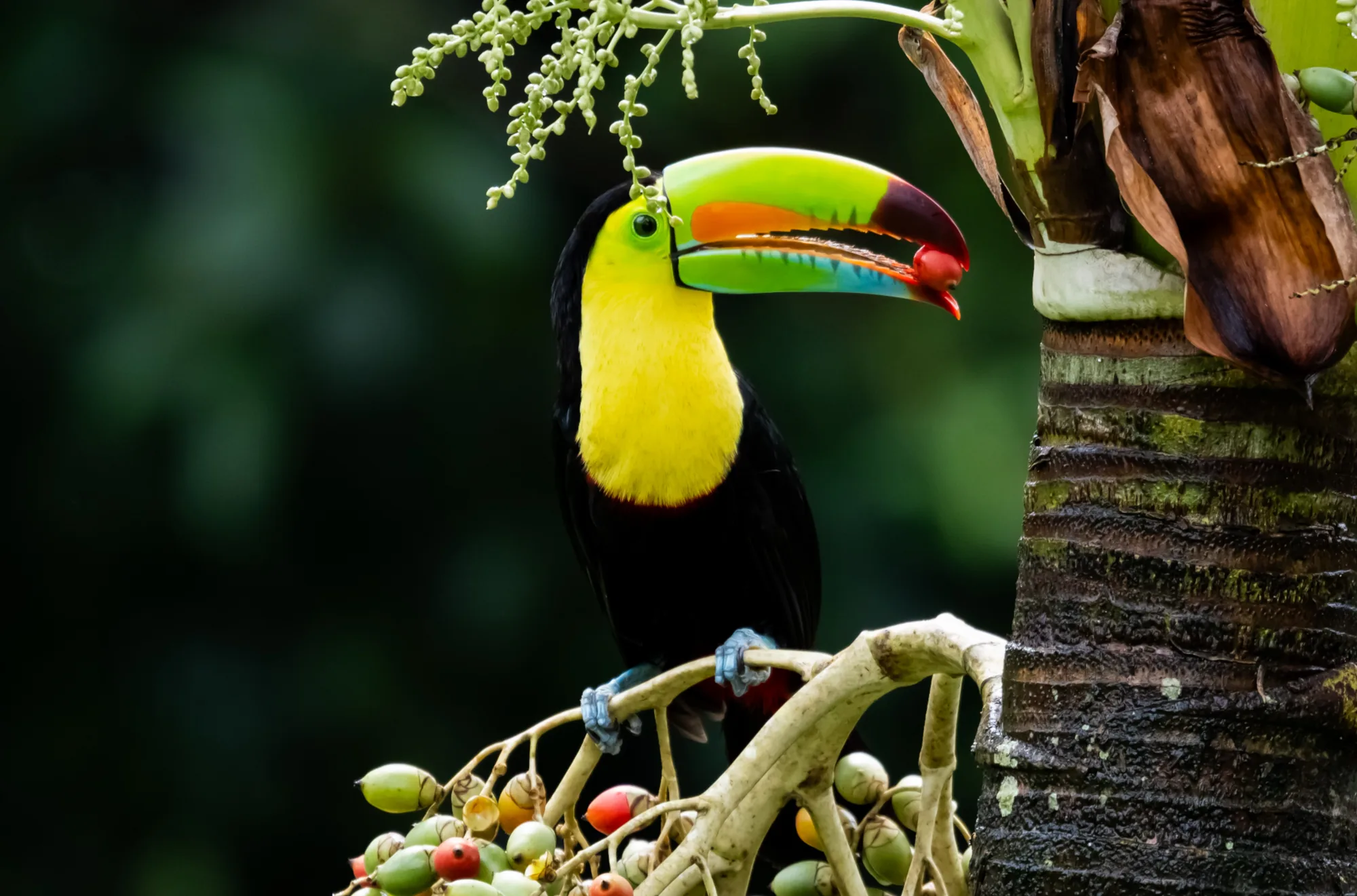
The Keel-billed Toucan (Ramphastos sulfuratus) is the one on every postcard — green, red, orange and blue all on one bill, no two exactly alike. Its range reaches down through the north and into the Nicoya Peninsula, so it does turn up on the Guanacaste side, favoring taller forest and forest edges. Listen for a repetitive, frog-like kreek kreek that carries surprisingly far.
Collared Aracari
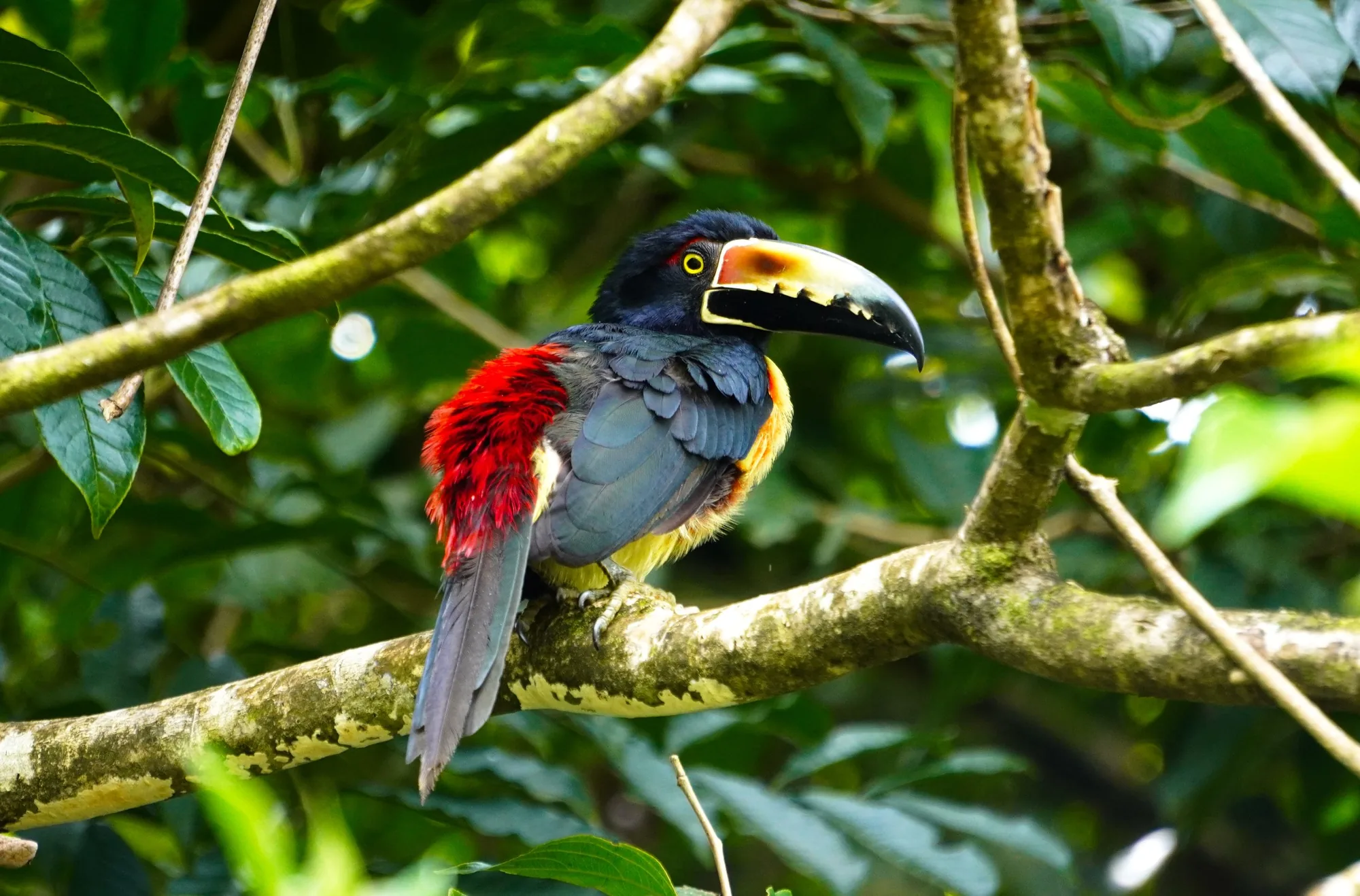
The Collared Aracari (Pteroglossus torquatus) moves in noisy bands of four to a dozen, sweeping through the canopy together from fruiting tree to fruiting tree. It’s common up in the Guanacaste cordillera and the Tenorio rainforest, and if you see one you’ll usually see several. Slimmer and faster-moving than the true toucans, with a dark head, yellow belly and a distinctive red-and-black band across the chest.
Fiery-billed Aracari
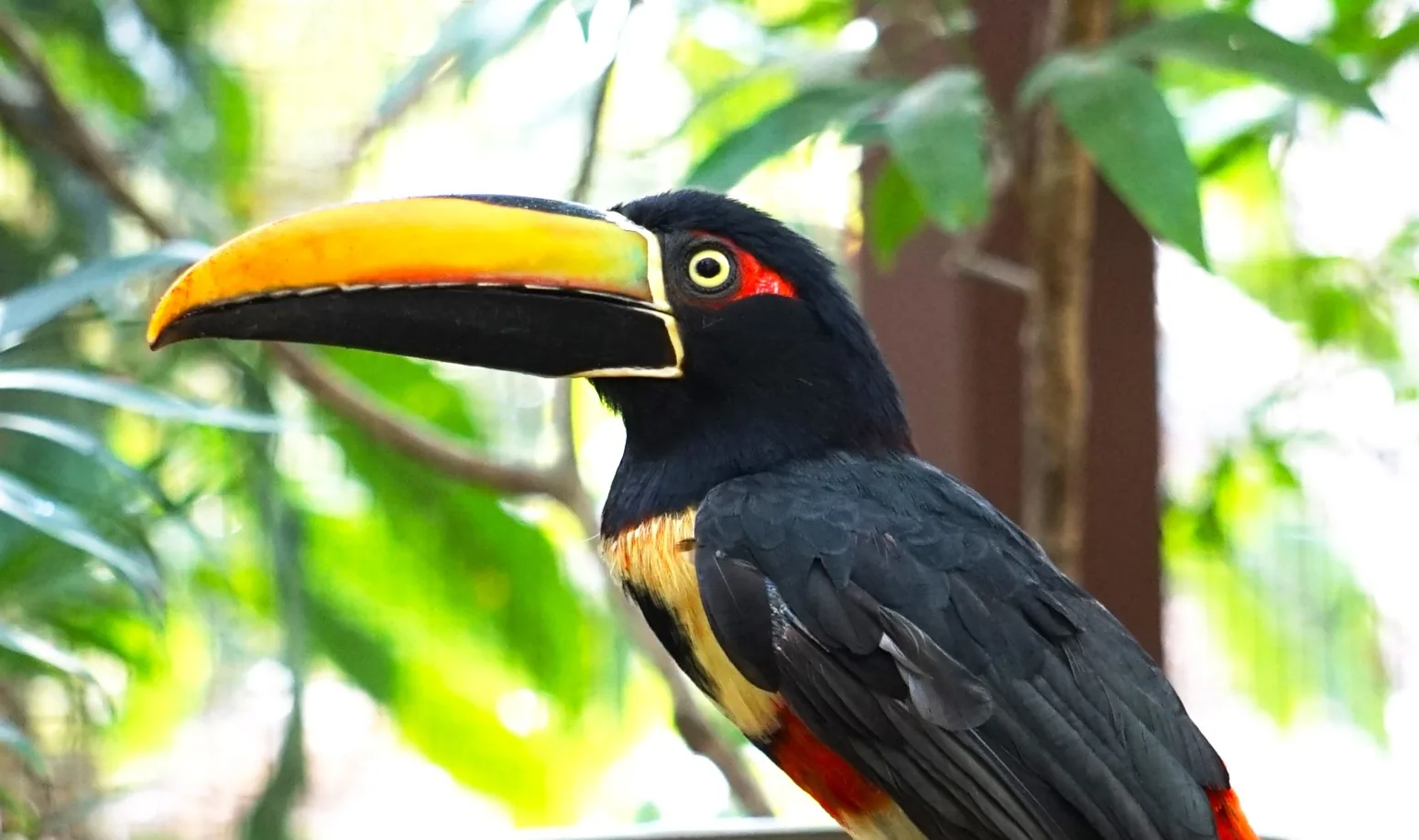
The Fiery-billed Aracari (Pteroglossus frantzii) is nearly restricted to Costa Rica and western Panama — a genuine target species for visiting birders. That orange-red bill blazes in the forest light. It replaces the Collared Aracari on the Pacific slope south of around Carara; in our zone you’re more likely to see the Collared, but the Fiery-billed turns up and is always a good find.
Emerald Toucanet
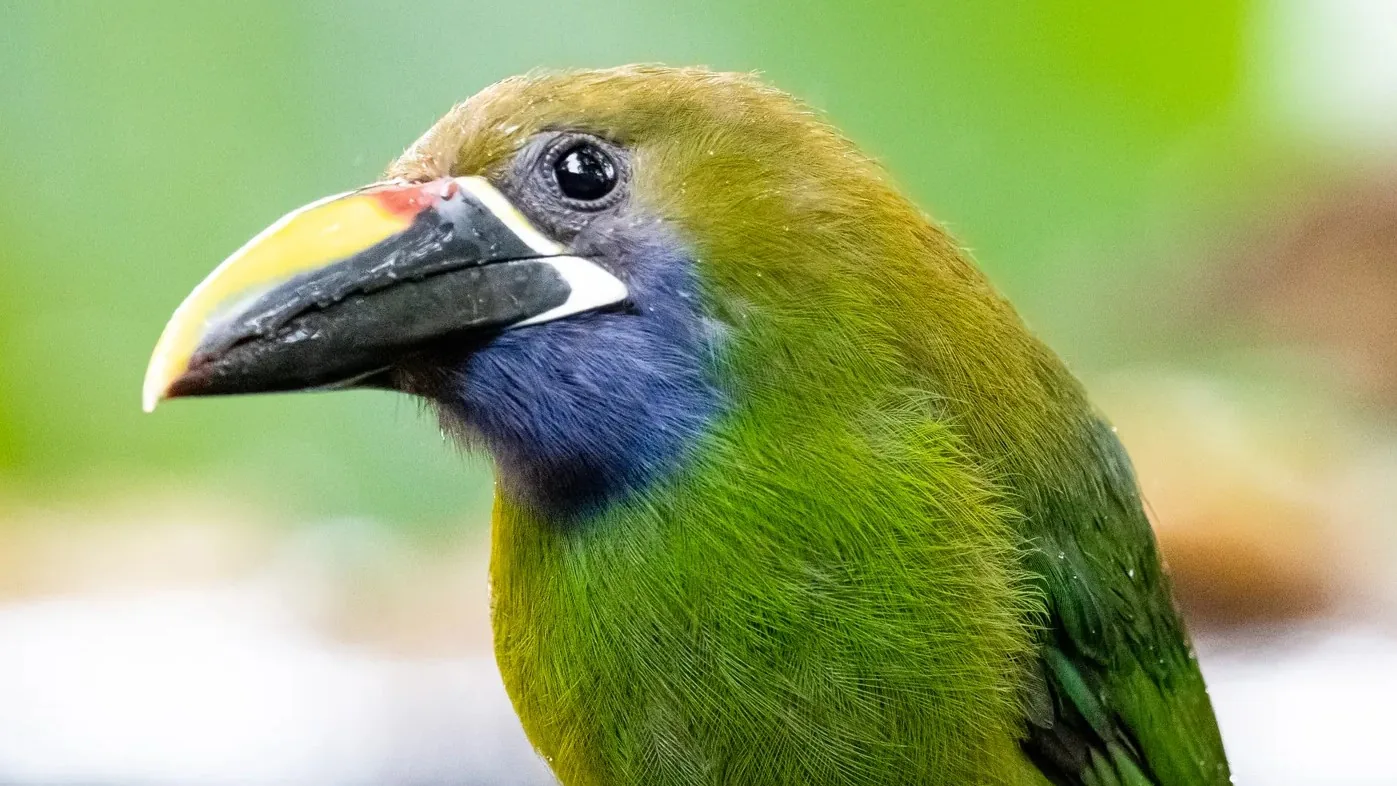
The Emerald (Blue-throated) Toucanet (Aulacorhynchus caeruleogularis) is compact and mostly olive-green with a blue throat — easy to overlook until you learn its shape. A mountain species that prefers higher elevations and cloud-forest edges; it follows the ridge of the Guanacaste cordillera and turns up on birding mornings in the right altitude band.
Yellow-eared Toucanet
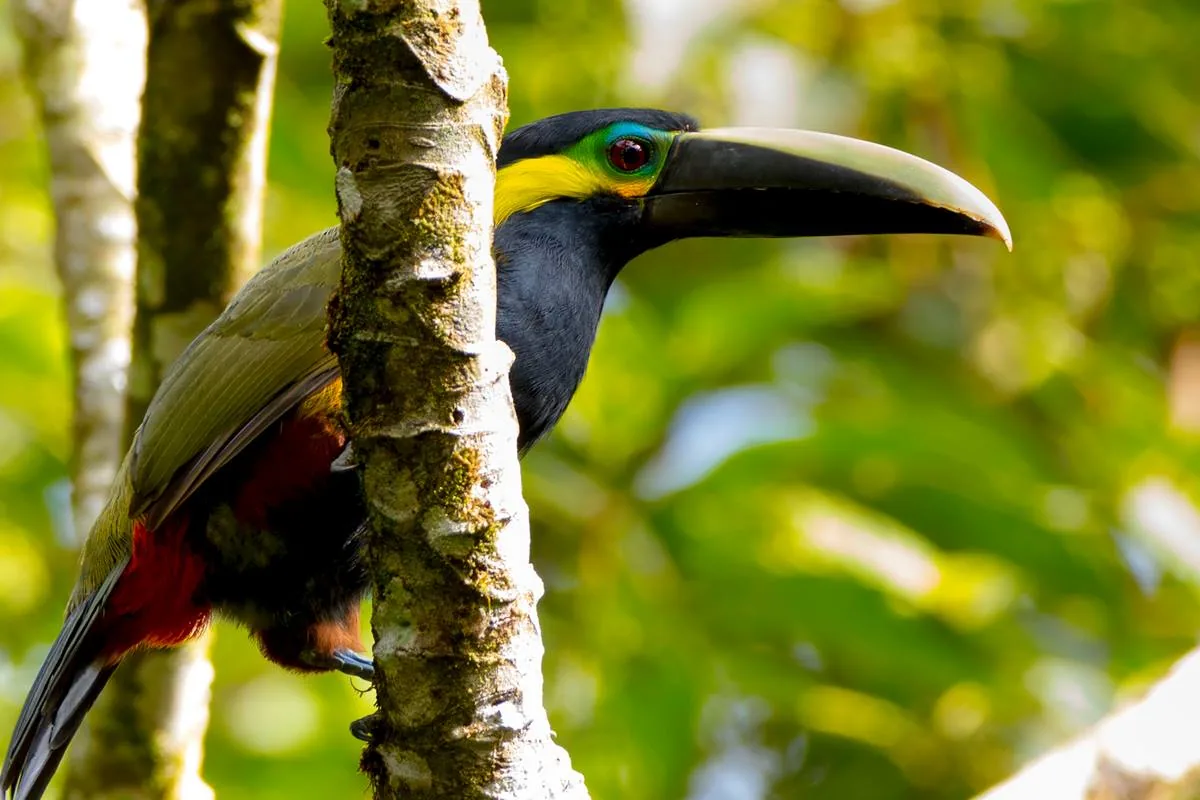
The Yellow-eared Toucanet (Selenidera spectabilis) is quieter and more secretive than its relatives — a bird birders specifically look for in the Tenorio rainforest corridor, where the Pacific and Caribbean slopes meet. The male’s yellow ear patch and red eye are distinctive; the female is more subdued.
Private tour from Guanacaste
Bird Watching in Costa Rica
A private birding day with a naturalist guide specialized in birds, in the cloud forest, wetlands or rainforest of northwest Costa Rica, where we go looking for toucans and much more. Private transport included.
What that bill is actually for
That bill isn’t for show — it’s a radiator. The huge, colorful bill is mostly hollow bone under a thin layer of keratin, laced with blood vessels. The bird adjusts blood flow through it to dump excess body heat — a real advantage in a hot, humid forest, and one reason toucans are so active in the early morning cool.
The bill also lets the bird reach fruit on branches too thin to carry its weight. Roughly three-quarters of the diet is fruit — figs, palm fruits, berries — making toucans some of the forest’s most important seed-dispersers. But they’re opportunists: they take insects, lizards, and the eggs or nestlings of smaller birds, especially in breeding season.
They nest in cavities they didn’t dig — old woodpecker holes, natural hollows — and a bird folds that long bill back over its shoulder to fit inside. In small flocks they “bill-fence,” tapping and clashing beaks; a keel-billed’s call can travel over a kilometre through dense forest.
Where toucans live — and where we take you
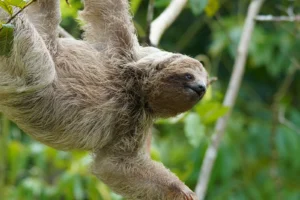
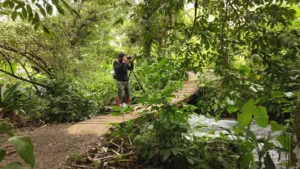
The best chances on our experiences are on trips that reach the wetter forest: the Tenorio rainforest — the Green Lagoon, the hanging bridges, the sloth encounter area, Río Celeste — that’s where toucans follow the fruiting trees. A naturalist who knows where those trees are fruiting this week makes the difference.
Toucans are non-migratory residents, so they’re around all year — but the green season (May–November) brings especially active mornings. Early light, before the heat, is when they move. Keep an eye on tall bare branches where they like to perch and call; the guide will pick out the shapes long before most people do.
Have a specific species in mind? Message Miller on WhatsApp — tell us what you’re hoping to see
The forest still has the last word
We won’t tell you you’ll definitely see one — no honest guide can promise a single species. What we can tell you is where they move, when they feed, and how to read the canopy for them.
Before you go looking
Yes, but not usually on the dry Pacific beaches. Toucans follow fruit and rainforest, so the reliable sightings are inland in the Tenorio rainforest. Three species are found there: the Collared Aracari, the Keel-billed Toucan, and the Yellow-throated (chestnut-mandibled) Toucan.
Six, in the toucan family (Ramphastidae): two large true toucans (Keel-billed and Yellow-throated), two aracaris (Collared and Fiery-billed), and two toucanets (Emerald/Blue-throated and Yellow-eared).
Reaching fruit on thin branches, signaling to other toucans — and releasing body heat. The bill is a lightweight hollow structure laced with blood vessels that works as a thermal radiator, helping the bird cool down in the tropical heat.
A guided day trip inland to the Tenorio rainforest, with a naturalist who knows where the fruiting trees are and can pick a toucan’s shape out of the canopy. That knowledge makes the difference between hearing one and seeing one.
See the rainforest where toucans live
Private tours from anywhere on the Guanacaste coast — your group, your guide, your pace.